What is Node.js? JavaScript on the Server Explained
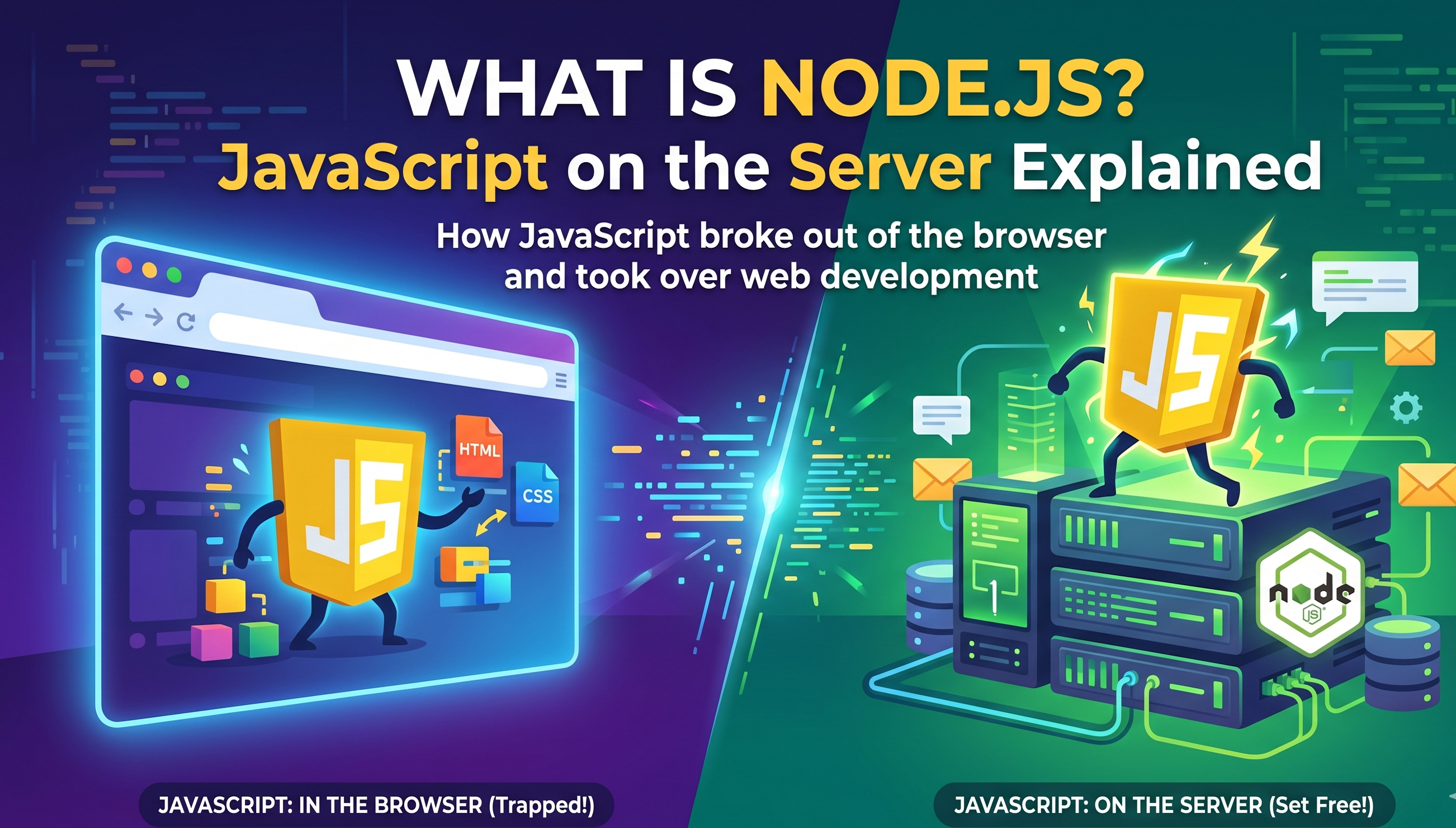
How JavaScript broke out of the browser and took over the web development world.
Full-stack developer and startup founder building tech solutions in Ayodhya. Vlogger with 27k+ followers sharing my journey in technology and SaaS.
If you are learning web development, you have definitely heard the word "Node.js". You see it in job postings, tutorials, and courses. But what exactly is it?
When I first started, I thought Node.js was a brand new programming language. I was relieved to find out that it is not! It is actually just JavaScript.
Today, we are going to learn what Node.js is, why it changed the web development world, and how it works—in simple, plain English.
The Old Days: JavaScript was Trapped
To understand why Node.js is so special, we have to look back at history.
When JavaScript was first created, it had one specific job: to make web pages interactive. It lived entirely inside your web browser (like Google Chrome or Firefox). It could change the color of a button, show a popup, or move an image.
But JavaScript was "trapped" inside the browser. It was not allowed to look at the files on your computer, and it definitely could not run on a web server. If you wanted to build the "back-end" (the server and database) of a website, you had to learn a completely different language, like PHP, Java, or Ruby.
What is a Runtime? (Language vs. Runtime)
Before we talk about Node.js, we need to understand the difference between a programming language and a runtime.
The Programming Language: This is just the grammar and vocabulary. It is the text you type, like
const name = "John";.The Runtime Environment: This is the machine that actually reads your text and does the work.
Your web browser has a built-in JavaScript runtime. That is why your browser understands JS.
Enter Node.js
In 2009, a smart developer named Ryan Dahl had a crazy idea. He took the super-fast JavaScript runtime out of the Google Chrome browser (called the V8 Engine) and put it inside a regular computer program.
He added some extra tools to let it read files and talk to the internet, and he called it Node.js.
Node.js is not a new language. It is just a runtime environment that allows JavaScript to run on a server, outside of a web browser.
Diagram: Browser JS vs Node.js
[ JavaScript Code ]
        |
        v
WHERE DOES IT RUN?
--------------------------------------------------------------
1. In the Browser ------------> Can change HTML, play sounds, click buttons.
                                (Cannot touch your computer files)

2. In Node.js (Server) -------> Can read files, talk to databases, send emails.
                                (Does not know what HTML or buttons are)
Why Developers Fell in Love with Node.js
Before Node.js, building a full website meant a developer had to switch their brain back and forth. They wrote JavaScript for the front-end, and then PHP or Java for the back-end.
Node.js fixed this. Suddenly, a developer could write JavaScript for everything. You only needed to learn one language to build an entire, full-stack application! This made it incredibly popular very quickly.
How Node.js Works (The Waiter Analogy)
Traditional back-end languages (like Java or PHP) handle users in a very strict way. Every time a new user visits the website, the server creates a new "worker" just for them. If the user asks for data from the database, the worker stops and waits until the data is ready. If a million users visit, you need a million workers, which takes up a lot of computer memory.
Node.js uses an Event-Driven Architecture. Instead of many workers, Node.js uses one super-fast worker.
Think of it like a waiter in a busy restaurant:
The waiter takes your order.
Instead of standing at your table waiting for your food to cook, the waiter drops the order at the kitchen and immediately goes to the next table.
When your food is finally ready, the kitchen rings a bell (an "event"), and the waiter brings it to you.
Because the Node.js "waiter" never stands around waiting, it can handle thousands of users at the exact same time using very little computer power!
Real-World Use Cases
Because Node.js is so fast at juggling many tasks at once, it is perfect for certain types of apps:
Chat Applications: Apps like WhatsApp or Discord need to send thousands of messages back and forth instantly. Node.js is perfect for this.
Streaming Services: Netflix uses Node.js to stream data quickly and smoothly.
Building APIs: Node.js is amazing at grabbing data from a database and sending it to a website or a mobile app.
Note: Node.js is NOT great for heavy math or video editing, because heavy calculations will make our single "waiter" get stuck!
Conclusion
Node.js changed the internet by setting JavaScript free from the browser. It allowed developers to build fast, scalable servers using a language they already knew.
If you know how to write an if statement or a function in JavaScript, congratulations! You are already halfway to writing your first Node.js server.


